In the future, you may find yourself asking which Massachusetts cities still run Flock Safety license plate readers. Judging from a statement issued today by the City of Salem, The Witch City1 won't be one of them much longer.
At around 4:30 p.m. on July 23, Salem posted a public statement announcing that it is not renewing the Salem Police Department's contract with Flock Safety, and that it will remove the Automatic License Plate Readers ("ALPRs") currently installed around the city. The reason given was not cost or performance, but data governance: the city said the protections around who owns and controls the ALPR data Flock's systems generate are insufficient.2
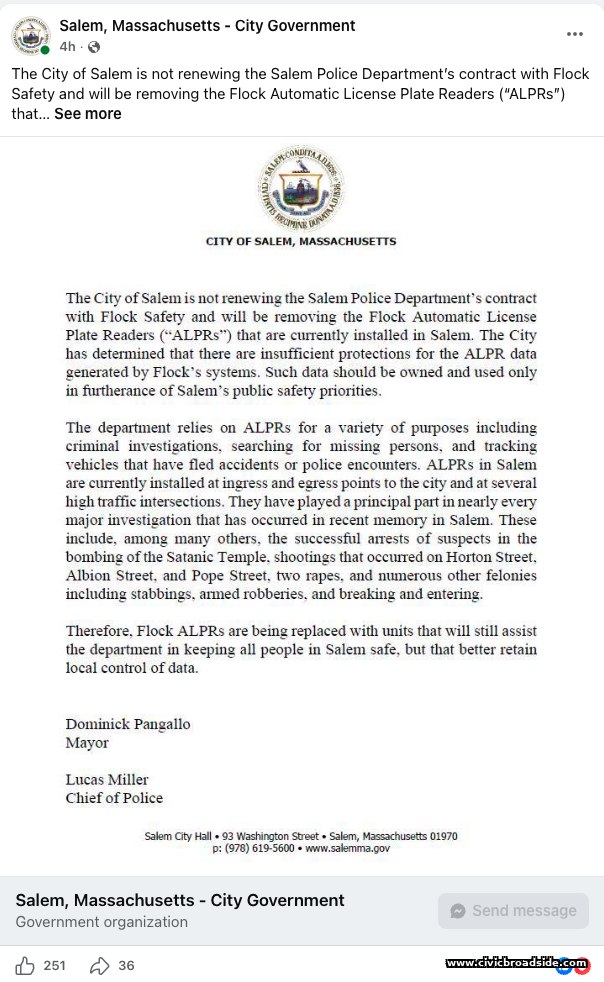
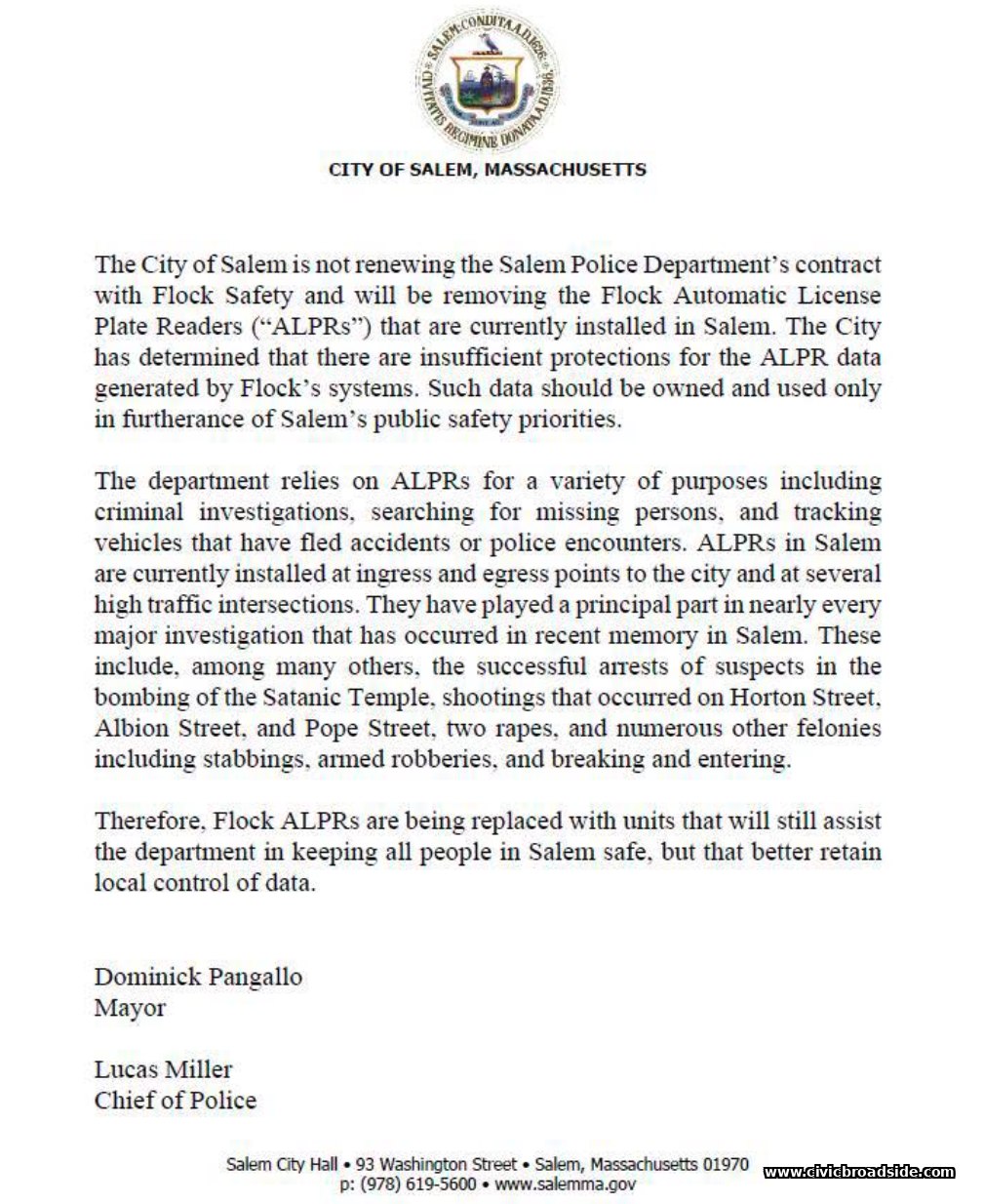
The City has determined that there are insufficient protections for the ALPR data generated by Flock's systems. Such data should be owned and used only in furtherance of Salem's public safety priorities.
Mayor Dominick Pangallo and Police Chief Lucas Miller signed the notice jointly. It credits Flock's readers with a role in "nearly every major investigation" in Salem in recent memory, including arrests in the Satanic Temple bombing case, several shootings, two rapes, and a string of stabbings, armed robberies, and breaking-and-entering cases. Salem isn't walking away from license plate readers as a tool. It's walking away from Flock as the vendor, saying the replacement units it plans to install will keep that investigative capability while keeping local control of the data.2
Malden's own Flock installation has clearly struck a nerve locally, judging by the response to MNN's July 15 story, "Birds on the Wire: The Silent Spread of Malden's Invisible Street Watchers." Salem's reversal raises an obvious question for Malden: what does the city's own contract say about data ownership, retention, and oversight — and is anyone in city government asking Salem's question here, too?
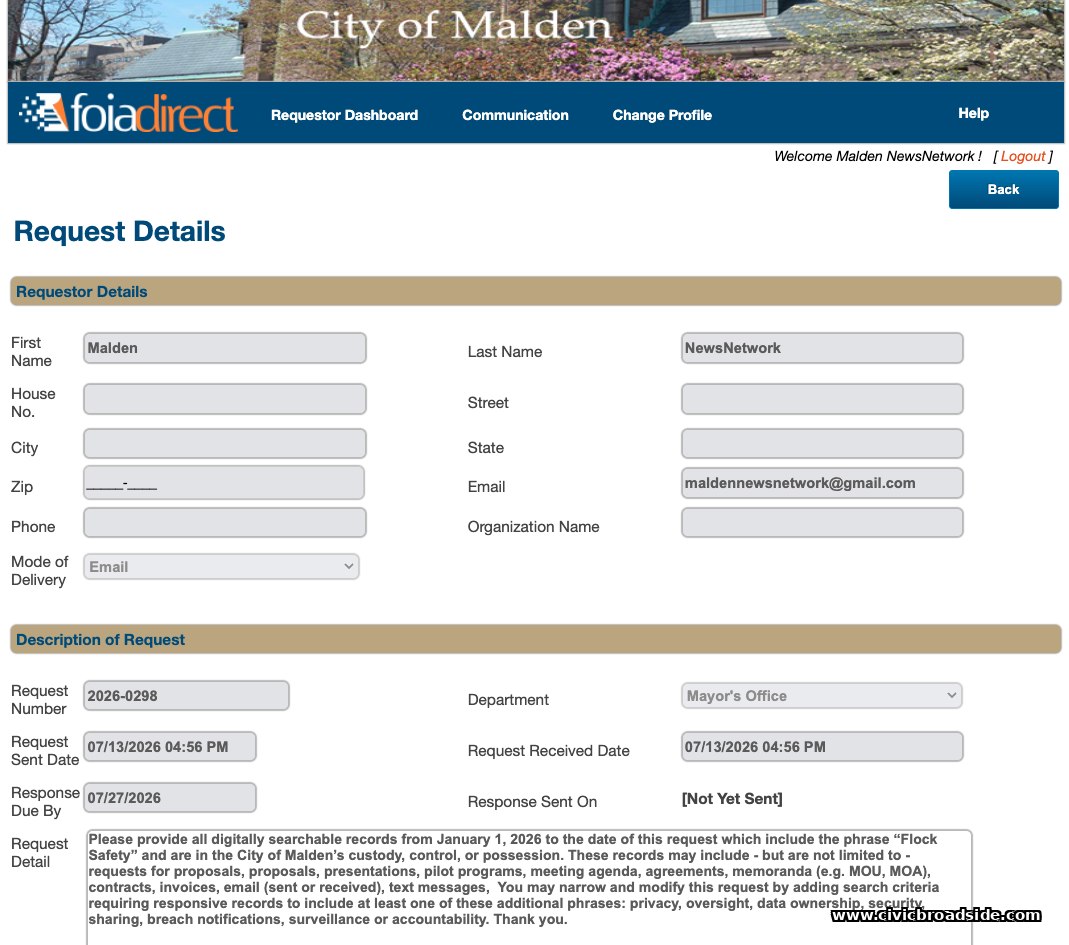
MNN has been trying to find out. On July 13, we sent the City of Malden a public records request seeking all digitally searchable records from January 1, 2026 forward that reference "Flock Safety" — proposals, pilot program records, agendas, contracts, invoices, email, and text messages — and offered to narrow the request around terms like privacy, oversight, data ownership, security, sharing, breach notification, surveillance, or accountability.
The city's response: an initial search on the phrase "Flock Safety" alone turned up nearly 3,000 emails, and the records custodian asked us to narrow the request, estimating two minutes of review per email for responsiveness and redaction.
That volume — almost 3,000 emails mentioning Flock Safety since January 1 alone — is itself notable. To make the review manageable for Malden's records custodians while keeping the request meaningful, MNN narrowed it. The revised request excludes email from maldenpd.org, maldenpd.com, or flocksafety.com addresses (on the theory that police department and vendor correspondence likely account for most of that volume, and can be requested separately), and asks instead for records containing all three of "Flock Safety," "privacy," and "data" — capped at the 50 most recent matching records if the narrowed set is still large.
We'll publish what comes back. In the meantime, Salem's notice is a useful yardstick: a neighboring city with its own serious violent crime caseload looked at the same vendor, decided the data protections didn't meet its standard, and said so publicly, on the record, with the mayor's and police chief's names attached. Malden hasn't yet said anything comparable — about Flock Safety or about what its own data governance terms actually are.