Over the past two decades or so, the Mystic Valley Regional Charter School has quietly assembled a real estate portfolio across Malden — 24 parcels, roughly $40.5 million in current assessed value, spanning Highland Avenue, Eastern Avenue, the Laurel/Jacob Street cluster, and most recently a Faulkner Street factory building. Some of that land came from other tax-exempt owners — the City itself, the Archdiocese, a former church — so its move onto MVRCS's books didn't remove anything new from Malden's tax rolls. But based on our current analysis, some 15 of those parcels, worth roughly $21.5 million, were bought from private, taxable owners: commercial buildings, multifamily homes, a funeral home, a florist's greenhouse, a window company. What's the impact on taxpayers?
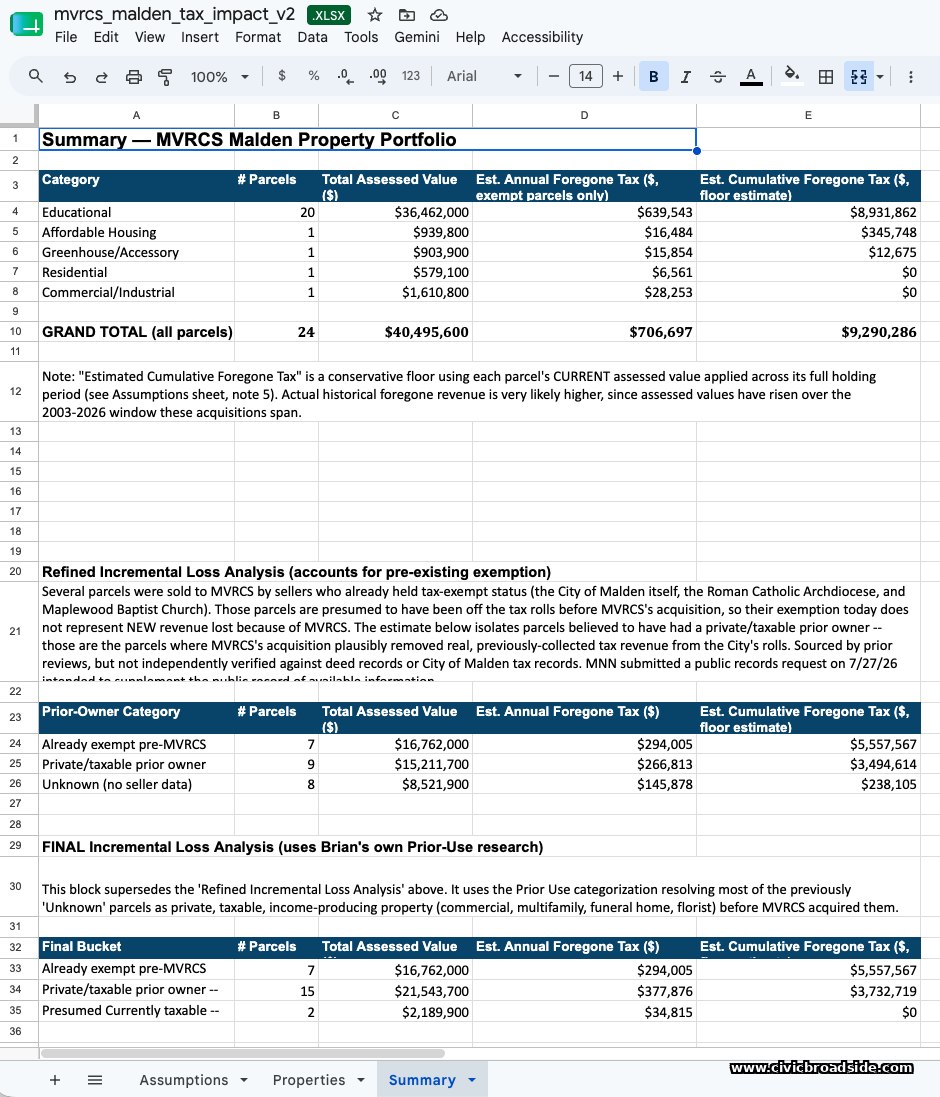
Using conservative, present-day assessed values and Malden's current tax rates1, that narrower set of parcels represents an estimated $377,876 a year in property tax revenue the City no longer collects — and a cumulative floor of roughly $3.7 million foregone since these properties changed hands. We call this a floor deliberately: it applies today's assessed values across each parcel's entire holding period, even though property values in Malden have risen steadily for twenty years. The true historical number, reconstructed year-by-year, is very likely higher, not lower.
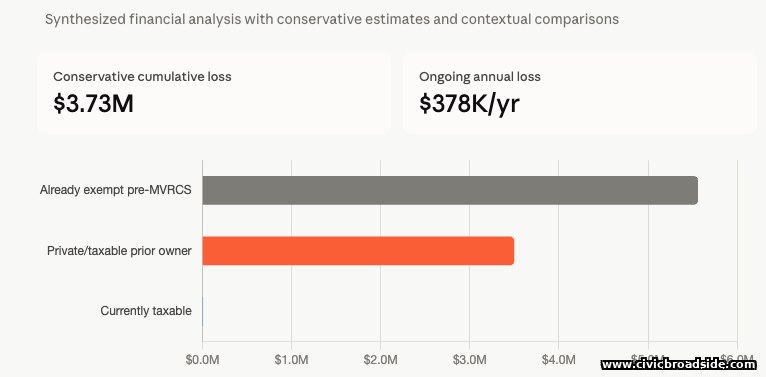
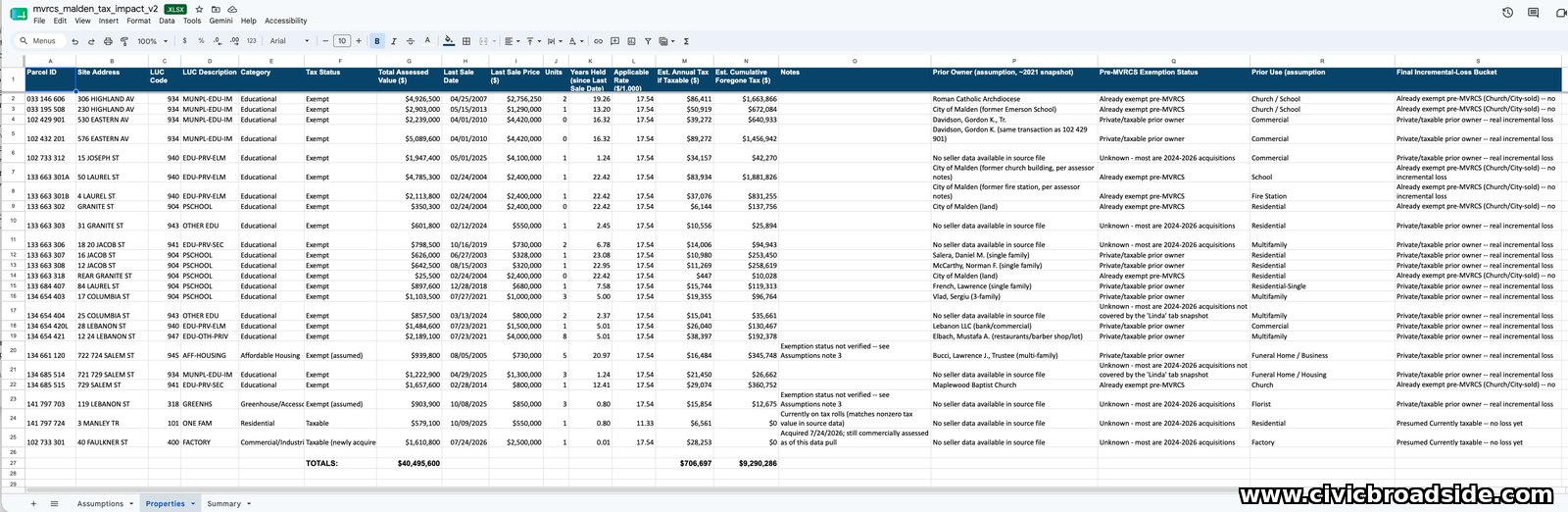
This estimate should be read with real humility, as we have made a reasonble effort constructing this model. It rests on assessor parcel records that may contain input errors, on inferred exemption status rather than confirmed exemption filings, and on prior-ownership research that has not yet been checked against deed records or the City's own tax history. Two parcels — one characterized as affordable-housing property and a greenhouse — are treated as fully exempt on an assumption that hasn't been verified, and Massachusetts law only exempts the portion of a property actually used for charitable purposes, so a mixed-use parcel could carry a smaller loss than modeled, or a larger one. Every number here is a well-sourced estimate, not an audited fact, and we'd rather understate the case than overstate it.
Every number here is a well-sourced estimate, not an audited fact — and we'd rather understate the case than overstate it.
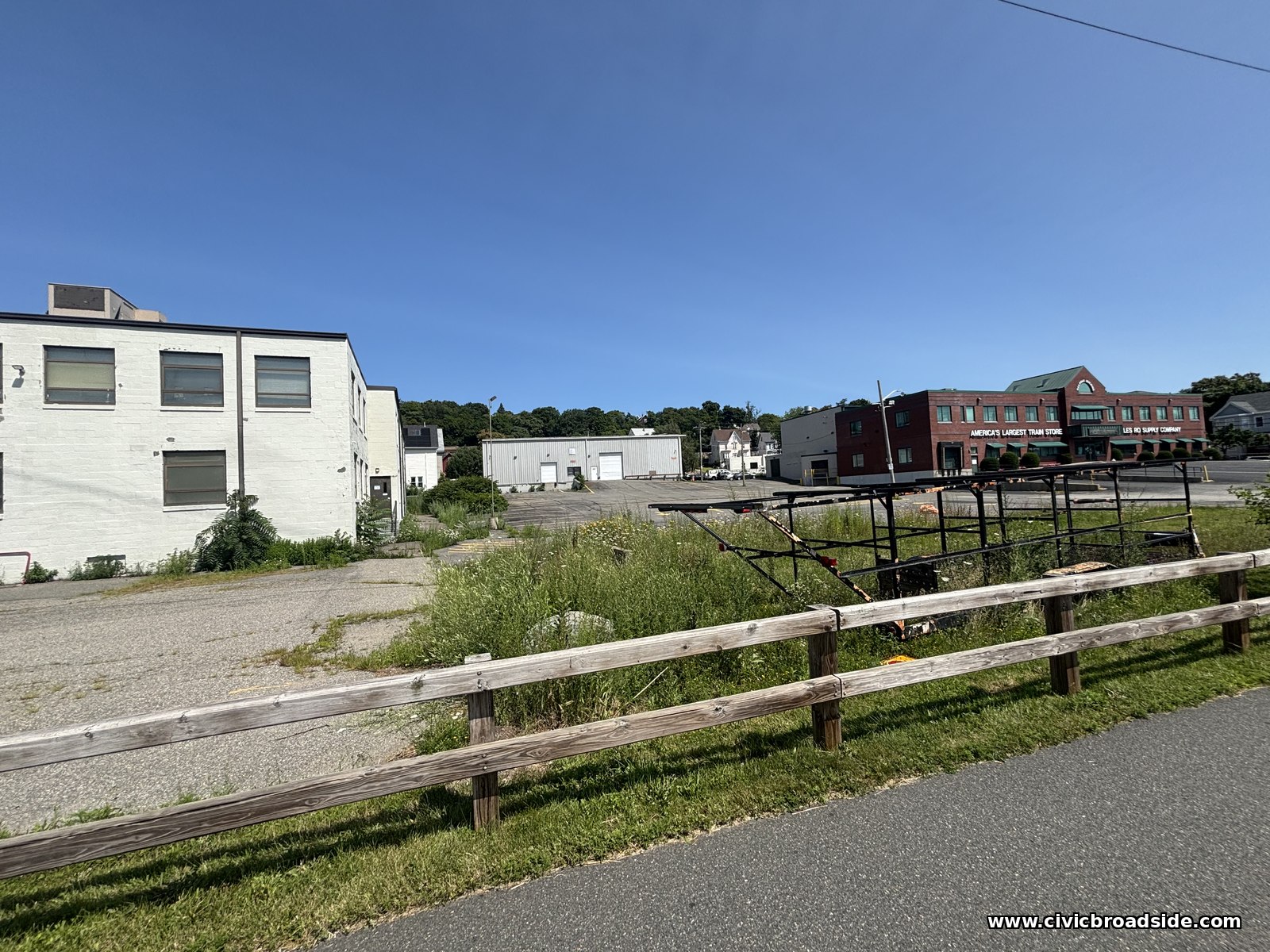
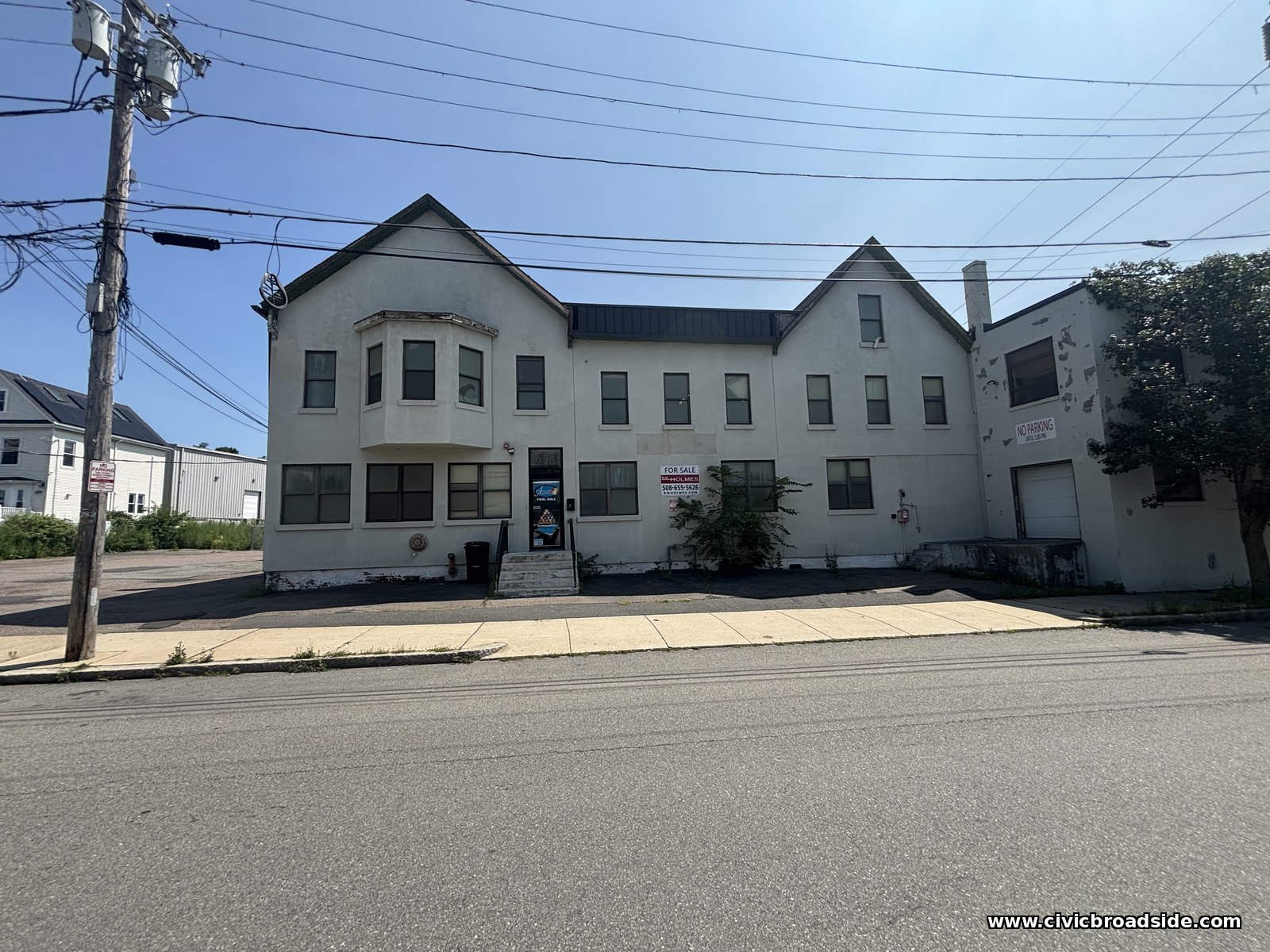
Some of these properties are easy to drive past without a second look: a converted house, a former commercial storefront, a small multifamily. Each one, though, once generated a tax bill.
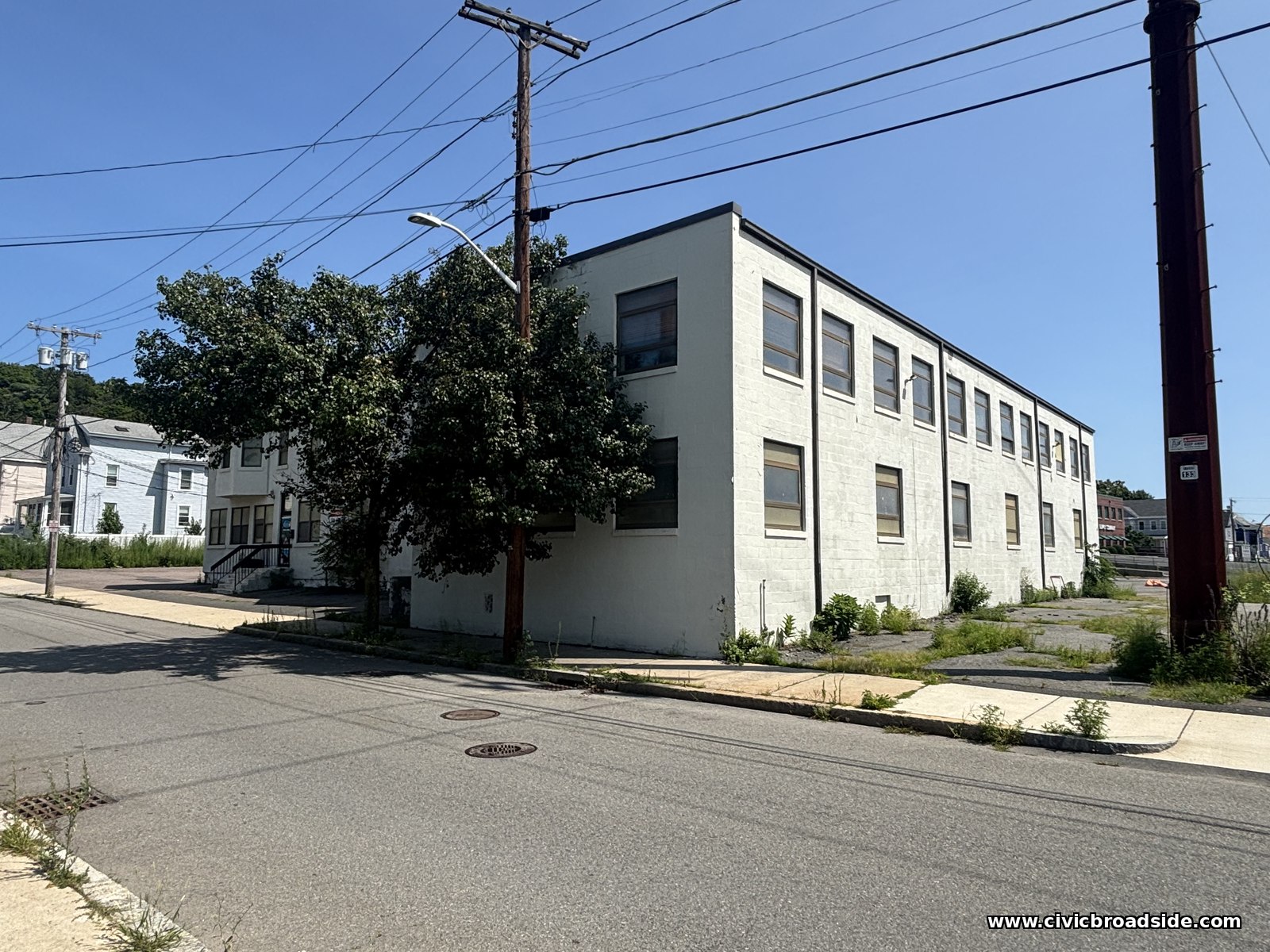
The pattern repeats across several neighborhoods: a private owner sells, the parcel converts to MVRCS's educational use, and the City's assessors reclassify it as exempt going forward.
A new legal wrinkle: In March 2026, the SJC told MVRCS it's a government agency, too
This story arrives alongside a significant, and directly relevant, legal development. On March 11, 2026, the Massachusetts Supreme Judicial Court ruled against Mystic Valley Regional Charter School in a case brought by the Attorney General.2 For years, MVRCS had refused to respond to public records requests, arguing that as a charter school it wasn't a government entity subject to the state's public records law at all — a position it maintained even after the state's supervisor of public records ordered it to comply, and even after the Attorney General's office got involved. The SJC disagreed, unanimously: Commonwealth charter schools, the Court held, are "agencies" under Massachusetts law, established for a public purpose, and therefore bound by the same public records obligations as any other government body.
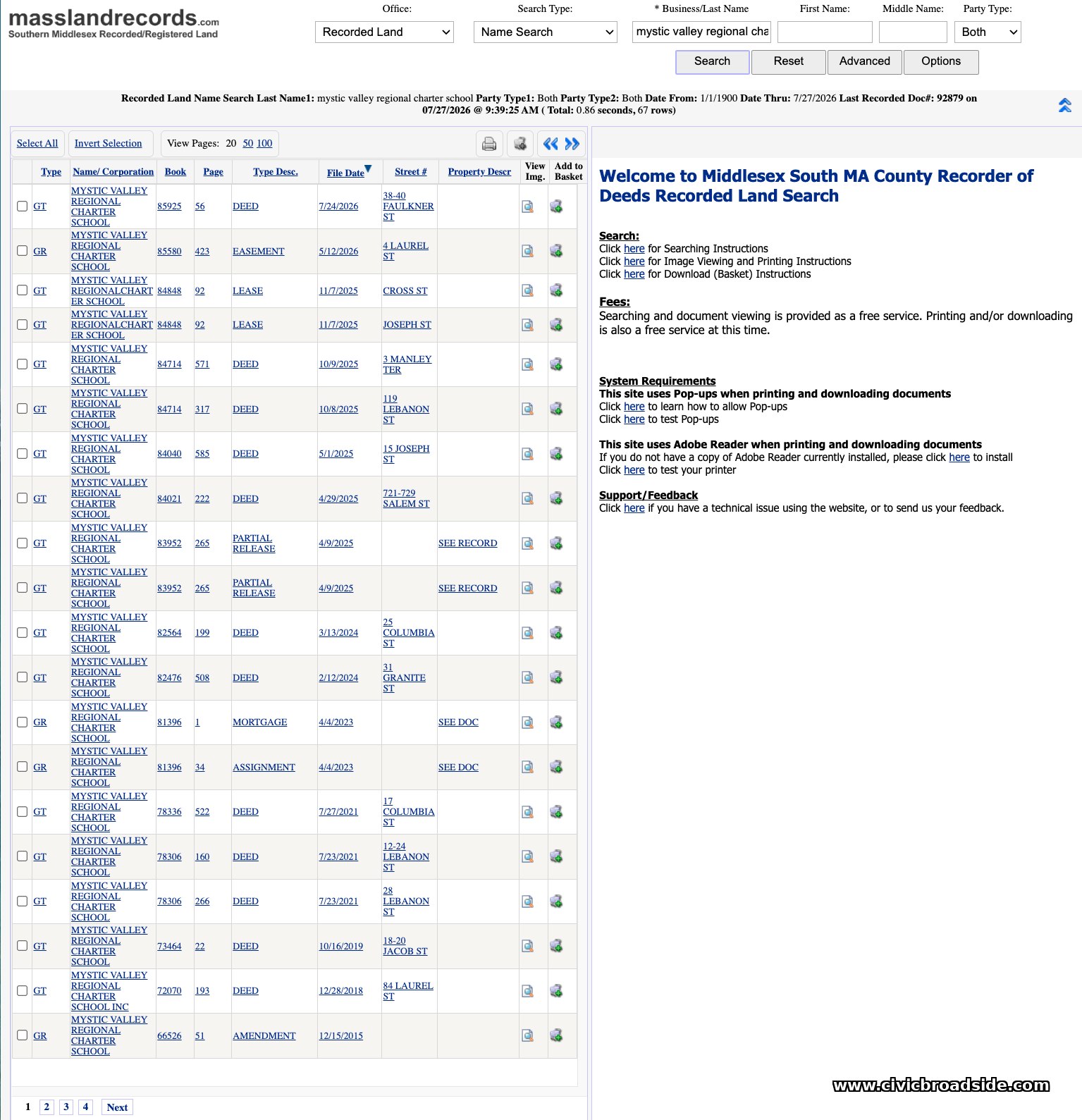
That ruling matters here because it closes the door MVRCS had been standing in. A public records request tied to this reporting was submitted to help verify the acquisition and exemption history described above; with the SJC's ruling now on the books, requests like it carry the weight of a binding, unanimous high-court decision behind them, not just a supervisor's order MVRCS could try to wait out.
This tax analysis should not be the last word from anyone outside City Hall. The people best positioned to turn this from an estimate into a defensible public figure are the City's own finance, assessing, and legal staff — they have access to full deed histories, exemption filings, and year-by-year valuation data that no outside model can replicate. Malden taxpayers deserve a number they can trust, and that number should carry the City's own signature, not just ours.
Given where Malden's finances stand right now, even a few hundred thousand dollars a year in foregone revenue is not a rounding error. It's a piece of the puzzle taxpayers are entitled to see clearly, whatever the final figure turns out to be. To that end, we're making the full underlying model available below — to the Finance Committee, for review at City Council and with the Mayor's office. It's built to be checked, corrected, and improved: every assumption is labeled, every formula is visible, and every caveat is documented on its own tab.
-
Read the opinion →SJC-13769 — Attorney General v. Mystic Valley Regional Charter SchoolThe Supreme Judicial Court's March 11, 2026 ruling that Commonwealth charter schools, including MVRCS, are government agencies subject to the state public records law.
-
View filing →Public records request — City of Malden10/9/2025 Quitclaim Deed, 3 Manley Terrace: $550,000.
-
View filing →Property Purchase7/24/2026 Quitclaim Deed, 38-40 Faulkner Street: $2,500,000.
-
Download model →MVRCS Malden property tax impact model (Excel)The full parcel-by-parcel workbook behind every figure in this piece — every formula and assumption is visible and editable.