A month ago, Governor Maura Healey signed the Commonwealth's Fiscal Year 2027 budget. Her office's press release at the time framed the public-safety provisions inside it as protecting survivors of sexual assault and strengthening tools to hold perpetrators accountable.1
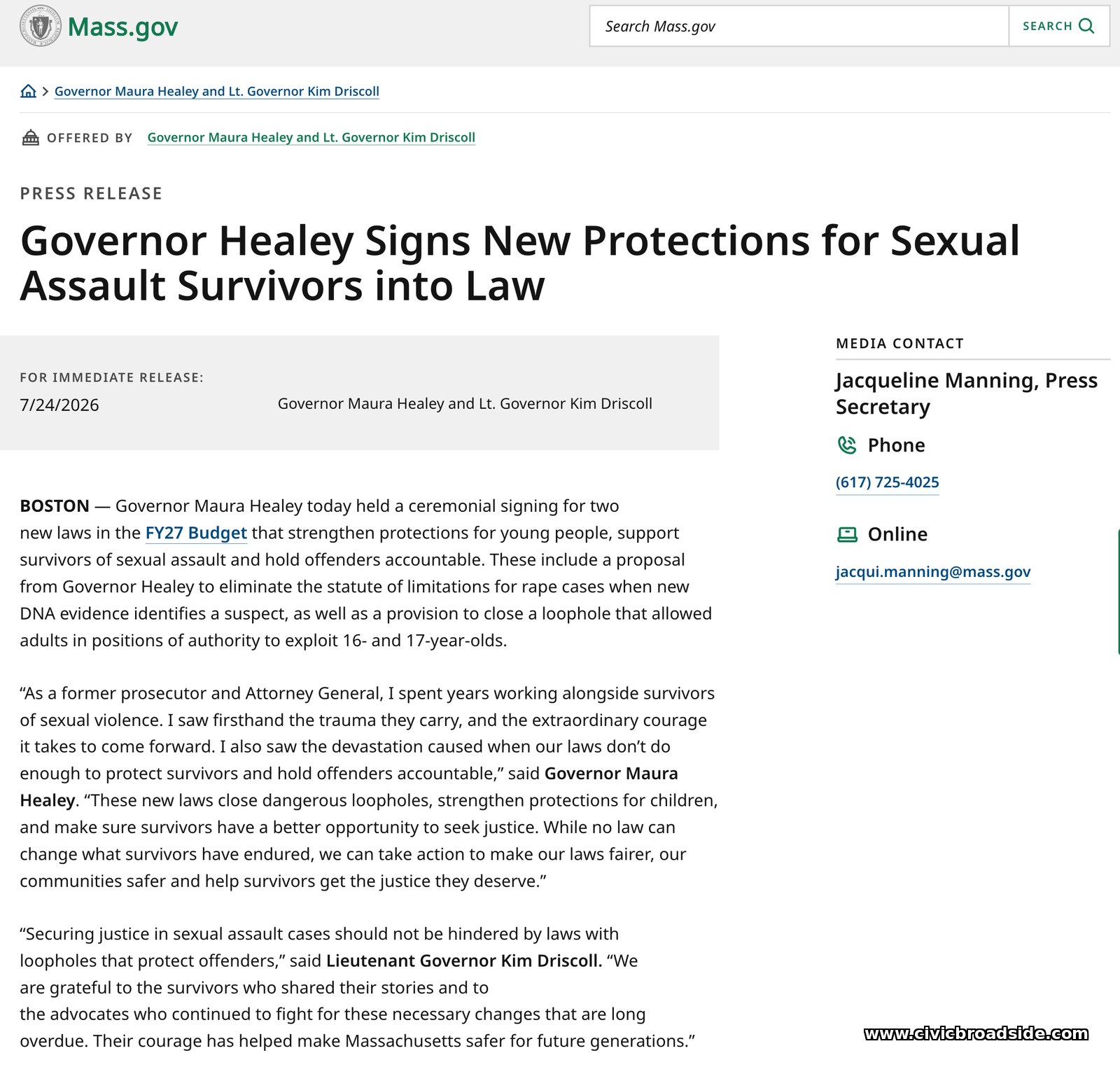
On July 24, Healey's office followed up with a second release, announcing a ceremonial signing for two of those provisions: a change allowing prosecutors to bring rape charges when DNA evidence identifies a suspect after the standard 15-year statute of limitations has run, and a separate provision closing a loophole that had allowed adults in positions of authority to exploit 16- and 17-year-olds.2 That second provision has become known as the Trusted Adults Act.
What the Law Does
Massachusetts' general age of consent is 16. Until this change, state law contained no specific prohibition on a teacher, coach, or other adult in a position of authority engaging in sexual conduct with a 16- or 17-year-old under their supervision — meaning an adult in that position could argue in court that the teenager had legally consented. The new law removes that defense: a minor under 18 cannot legally consent to sexual conduct with an adult who holds, or has held, a position of trust or authority over them, including teachers, coaches, police officers, social workers, and other mandated reporters. An offender cannot avoid prosecution simply because the position of authority has since ended.2
Where the Bill Came From
The provision has a joint origin. State Senator Joan B. Lovely (D-Salem) filed Senate Bill S.1163 on January 16, 2025 — the third consecutive legislative session in which she had introduced this proposal.3 One day earlier, State Representative Leigh Davis (D-3rd Berkshire) — then newly sworn into her first term — filed the companion House Bill H.1634.4 In her own account of the session, Davis credited Lovely's "years of leadership" for paving the way, while noting that seeing a bill she filed within days of taking office become law was, in her words, a reminder of what sustained advocacy can accomplish.5 Both bills were referred to the Judiciary Committee, and after a hearing in June 2025, the Senate bill was reported favorably to Senate Ways and Means that July — ultimately being folded into the FY27 budget as an outside section rather than passed as standalone legislation.
Where Massachusetts Stood
Before this change, Massachusetts was one of only 11 states without a law specifically addressing sexual conduct by school employees and other authority figures with minors above the state's age of consent, according to Jetta Bernier, executive director of the child-abuse-prevention organization Enough Abuse, who had pushed for this change for roughly two decades.6
What the Law Does Not Do
A few limits are worth naming plainly, since they don't always survive a press release. The law applies prospectively — it does not reach back to criminalize conduct that occurred before its effective date, and by at least one legal analysis it took effect July 1, 2026.7 It does not change the general age of consent in Massachusetts, which remains 16; it adds a separate, narrower prohibition specific to relationships involving authority or supervision. And it does not itself change what happens after arrest and prosecution — it changes what defense is available at trial, not sentencing or diversion, which remain governed by existing law.
-
View Image →Mass.gov press release, July 9, 2026 (FY27 budget signing)
-
View Image →Mass.gov press release, July 24, 2026 (ceremonial signing)
-
View PDF →Senate Bill S.1163, as filed
-
View PDF →House Bill H.1634, as filed
-
View source →Leigh Davis, "Commonwealth Connections: A first term of results," The Berkshire Edge, August 4, 2026
-
View source →Boston 25 Investigates reporting on the age-of-consent loophole (Jetta Bernier, Enough Abuse)
-
View source →Massachusetts Passes Legislation to Close Age of Consent Loophole, Shipman & Goodwin LLP