For years, records requesters in Massachusetts have run into the same wall from two different directions. Ask whether a public body's closed-door meeting was lawful, and the Attorney General's Division of Open Government will tell you. Ask whether a public body's redacted minutes were lawfully withheld, and a completely different office — the Supervisor of Records, housed under the Secretary of the Commonwealth — will handle that.1 Two co-equal agencies, two separate dockets, and as far as either process requires, limited public facing interacton between the two. The result is a structural gap: a public body can be found to have violated the Open Meeting Law, but if the minutes were redacted under a claimed privilege, it isn't clear the Supervisor of Records will ever know about that.
Call it what it is: a grand canyon. Rim to rim, it has taken years for us to cross — one document request, one appeal, one complaint at a time. What follows is the clearest documentation yet of hazards of traversing this grand canyon of transparency.
A redaction, disclosed
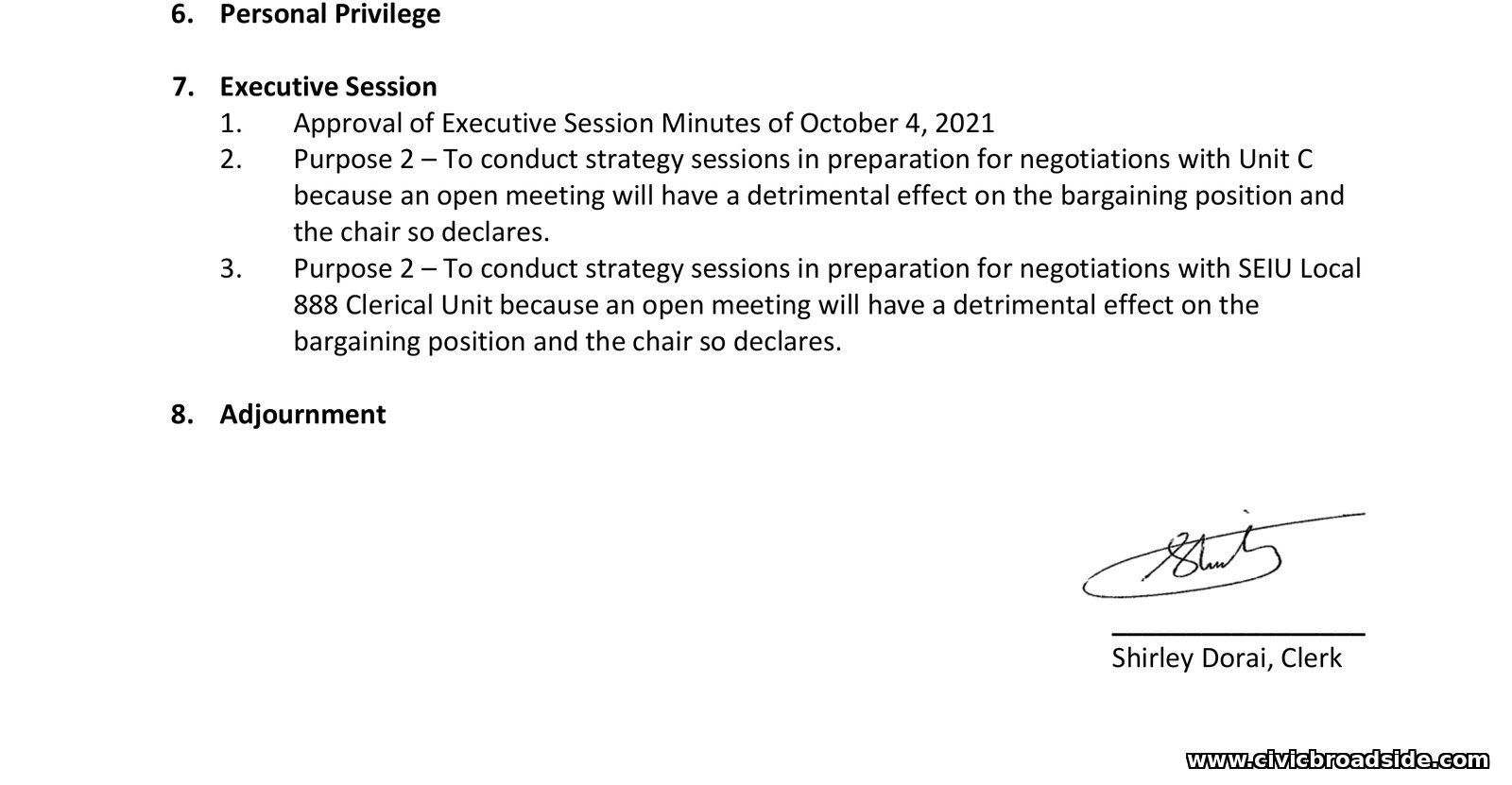
On November 8, 2021, the Malden School Committee's posted agenda listed three items for executive session: approval of prior minutes, and two rounds of union contract negotiations. Nothing on that agenda mentioned litigation. But now we know, litigation was discussed.
The minutes of that session have been publicly posted at maldenps.org for years, signed by the Clerk at that time — and released to the public in redacted form. A block of content following the third noticed item is blacked out entirely before the minutes resume for adjournment. The public has long been able to see that something was withheld there. But the public could not see what was hidden all these years behind redactions.
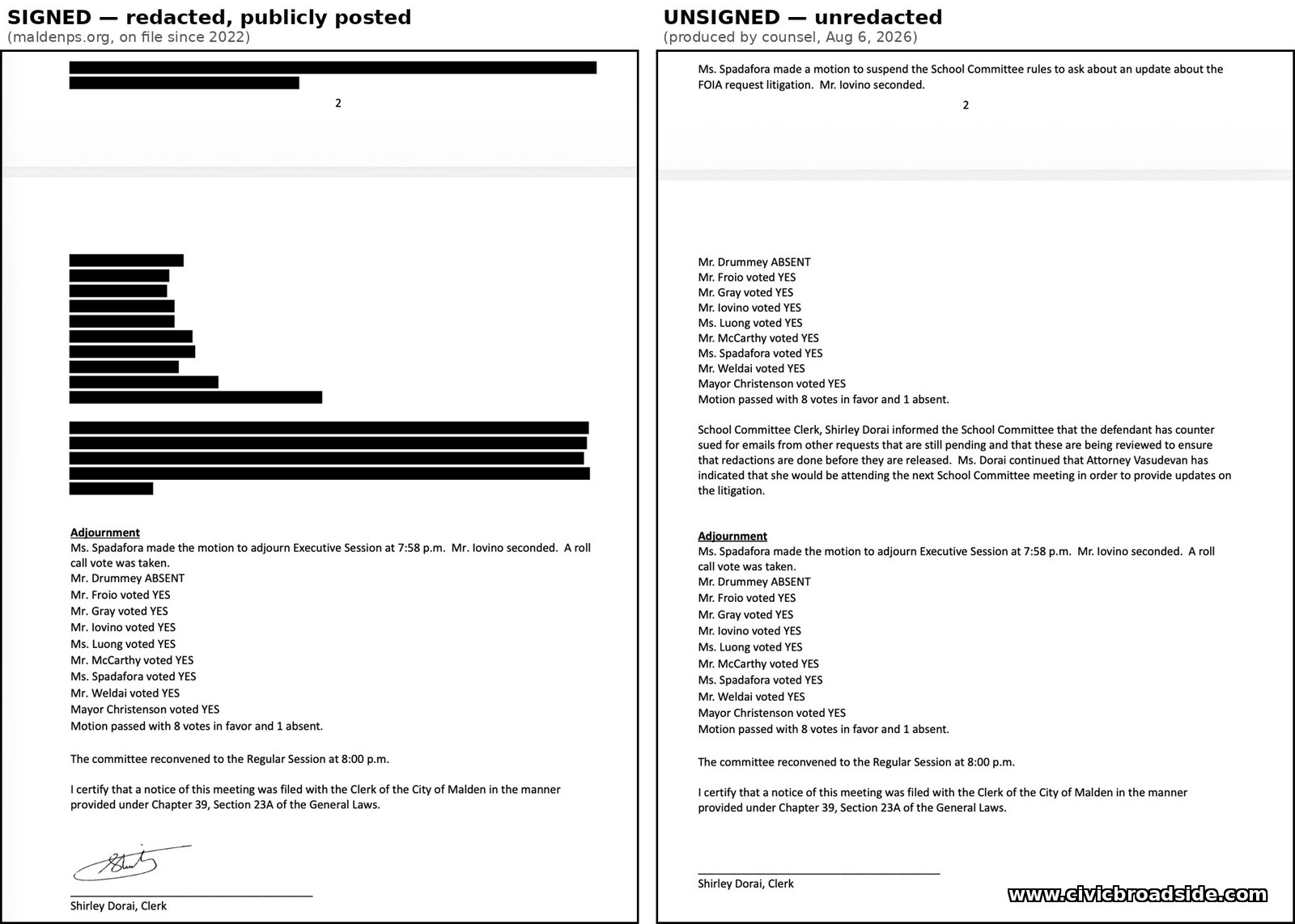
A small detail in the file names themselves is easy to miss but it is worth pausing on. The long-public, signed version is the one that has always carried the weight of a final record — it was executed, posted, and treated as complete for four and a half years. The version produced on August 6, 2026, unsigned and only very recently seen, is the now labeled "DRAFT." In an ordinary document's life, a draft precedes a final and is superseded by it. Here the sequence runs backwards: the "DRAFT" surfaces years after the "FINAL" was signed and made public. Now we can see, it is the draft — not the final — that turns out to be complete. The "FINAL" withheld key information from the public while this new "DRAFT" does not.
That changed on August 6, 2026, when the School Committee's outside counsel pointed MNN to a second, unsigned version of the same minutes. We learned about this in response to a public records request by Malden News Network for those minutes. What the redaction had concealed, the new copy revealed: a vote to "suspend the School Committee rules" was followed by a School Committee discussion on "the FOIA request litigation"; the minutes report that the district had been countersued over other public records requests, with redactions being prepared before release; and a statement that outside counsel would brief the Committee further at a future meeting. None of that was on the noticed agenda.
“Unredacted executive session minutes for November 8, 2021 meeting of the Committee are publicly available and accessible at the Committee website.” — Howard Greenspan, Esq., letter to Malden News Network, August 6, 2026
The unredacted version had not been publicly posted or known to us before counsel's recent response to our public records request produced it.
Why the timing matters
Two days earlier, in a separate letter defending the Committee against an unrelated Open Meeting Law complaint, the same counsel told the Attorney General's office something more sweeping:
“The School Committee acknowledges its duty under the Open Meeting Law to identify and describe pending litigation to be discussed under Purpose 3 with specificity in meeting notices and has done so since July 2021.” — Howard Greenspan, Esq., letter to the AGO Division of Open Government, August 4, 2026
The November 2021 meeting falls squarely inside that claimed compliance window. Yet, by counsel's own supplied record, we see a session where litigation was discussed with no notice.2 Under the Open Meeting Law, a public body can only discuss what it has told the public it intends to discuss.2 This mismatch between agenda and content appears to be a violation —3 and it sits inside window of time the Committee has pointed to as evidence of its own good practice.
Where the grand canyon opens up
Here is where the two-agency gap becomes more than an abstraction - it can become a lost view. If the Attorney General's office rules narrowly — was a discussion within its noticed purpose, yes or no — it can resolve the Open Meeting Law question without ever reaching the deeper gaps of disclosure. When and by whom was this new redaction cleared for release? Why was it described as though that had been public all along. That question belongs, if anywhere, to the Public Records Law4 and the Supervisor of Records5 — a different office, with a different docket, that appears to have no standing mechanism to learn an Open Meeting Law complaint even exists, let alone what it found.
Counsel's citation of that boundary was not offered as a courtesy to future readers. It appears in a letter defending the Committee, at the exact moment the underlying redaction questions were most exposed, and it was the only way to make the argument he needed to make: that the Division should go no further than the noticed-purpose question in front of it. To draw that line for the AGO, he had to state precisely where his own privilege claims stop being reviewable by the body he was writing to. It is the clearest the boundary has ever been drawn — not volunteered, but required, because the alternative was leaving the door open.
This publication's own records history with Malden shows the pattern isn't limited to one meeting. A set of executive session minutes from 2023 was found, on appeal, to have been over-redacted under an attorney-client privilege claim the Supervisor of Records ultimately found the district hadn't adequately supported.
This is the very kind of claim that tends to be waved through on a "trust the custodian" presumption at the first pass. That appeal ran its full course, years after the underlying meetings, entirely inside the Public Records track. The Open Meeting Law process for the sessions in question never touched it, and had no occasion to.
Two systems, each competent within its own lane, each structurally blind to the other's findings. A public body only has to win in whichever lane is currently open.
Closing the gap
None of this requires new legislation. What it requires is coordination and collaboration that doesn't currently exist by default: an Open Meeting Law complaint that puts the Supervisor of Records on notice when the underlying dispute is really about the accuracy of a record, not just the lawfulness of a meeting; and a willingness from both offices to treat a documented discrepancy — a redaction, quietly lifted, and described inaccurately in the process — as a shared fact pattern rather than two separate, unrelated filings.
The AGO and the SPR can and do work together (that's how the Mystic Valley Regional Charter School case made it all the way to the Supreme Judicial Court). When a public body has been found to have violated the Open Meeting Law, we are not aware of any statute that requires the Supervisor of Records be notified of that finding, even if it is directly relevant to a redaction claim.
We ask the Attorney General's Division of Open Government to read this story: review the November 2021 minutes in both versions, determine whether the session exceeded its notice, and refer what it finds to the Supervisor of Records rather than let the question die at the edge of its own jurisdiction — which is exactly where this story starts to matter most.1
It is a small, procedural ask. But procedural gaps are exactly how a grand canyon this wide gets crossed one bridge at a time — and after years of watching claims of privilege and litigation granted more faith than they've earned, a documented, dated, real-time discrepancy like we have here is the clearest evidence yet that the crossing is worth making.
-
View PDF →MNN's July 31, 2026 Public Records request for unredacted executive session minutes
-
View PDF →Nov 8, 2021 docket for the Regular and Executive Session meeting, as posted
-
View PDF →Nov 8, 2021 minutes — signed, redacted, publicly posted
-
View PDF →Nov 8, 2021 minutes — unsigned, unredacted, produced Aug 6, 2026
-
View PDF →Greenspan letter to AGO, Aug 4, 2026 ('...has done so since July 2021')
-
View PDF →Greenspan PRR response, Aug 6, 2026 ('...publicly available...unredacted')
-
View PDF →Friedman OML complaint, June 25, 2026
-
View PDF →Supervisor of Records determination, SPR 25/0231
-
View PDF →SPR 25/0231 in camera review record